This session started with an introduction to Ethics. This included discussing the existence of ethical teachings in many religions, the various ethical and metaethical forms of judgment, the different types of Ethics, and looking at the subject of Ethics from the two descriptive and prescriptive perspectives. Afterwards, explanations were given about Islamic ethics and Islamic metaethics. The next subject of this discussion was the relation between religion and ethics, where the meaning of religious ethics was stated from different perspectives. Ethics in the Islamic culture, the different approaches used in the study of Islamic ethics (narrative, philosophical, mystical, and combined), and metaethics in the Islamic culture were also among the topics addressed in this session. At the end of the session questions were answered from participants.
Category: Workshops Summer 2021
An introduction to Islamic Ethics – Pt.2
This session started with an introduction to Ethics. This included discussing the existence of ethical teachings in many religions, the various ethical and metaethical forms of judgment, the different types of Ethics, and looking at the subject of Ethics from the two descriptive and prescriptive perspectives. Afterwards, explanations were given about Islamic ethics and Islamic metaethics. The next subject of this discussion was the relation between religion and ethics, where the meaning of religious ethics was stated from different perspectives. Ethics in the Islamic culture, the different approaches used in the study of Islamic ethics (narrative, philosophical, mystical, and combined), and metaethics in the Islamic culture were also among the topics addressed in this session. At the end of the session questions were answered from participants.
An introduction to Islamic Ethics – Pt.1
This session started with an introduction to Ethics. This included discussing the existence of ethical teachings in many religions, the various ethical and metaethical forms of judgment, the different types of Ethics, and looking at the subject of Ethics from the two descriptive and prescriptive perspectives. Afterwards, explanations were given about Islamic ethics and Islamic metaethics. The next subject of this discussion was the relation between religion and ethics, where the meaning of religious ethics was stated from different perspectives. Ethics in the Islamic culture, the different approaches used in the study of Islamic ethics (narrative, philosophical, mystical, and combined), and metaethics in the Islamic culture were also among the topics addressed in this session. At the end of the session questions were answered from participants.
Philosophy and Islamic theology (Ilm al-Kalām) – Pt.3
At the beginning of this session the meaning of “philosophy” and “Islamic philosophy” were both discussed. It was said that the definition of Islamic philosophy sits in opposition to two major traditional streams of philosophy: Western philosophy and Eastern philosophy. Three essential questions regarding Islamic philosophy, namely meaning, possibility, and the realization of Islamic philosophy, were also addressed. Different perspectives about the relation between Islamic philosophy and Western philosophy (Greek and Alexandrian), as well as examples of the definition of philosophy according to Muslim philosophers were mentioned. There was also a discussion on the different schools of Islamic philosophy, including their structures and sources. The second half of the session was dedicated to discussing “Kalam”. This included talking about definitions for Kalam and Ilm Al-Kalam, as well as the relation between Kalam and philosophy. At the end of the session questions were answered from participants.
Philosophy and Islamic theology (Ilm al-Kalām) – Pt.2
At the beginning of this session the meaning of “philosophy” and “Islamic philosophy” were both discussed. It was said that the definition of Islamic philosophy sits in opposition to two major traditional streams of philosophy: Western philosophy and Eastern philosophy. Three essential questions regarding Islamic philosophy, namely meaning, possibility, and the realization of Islamic philosophy, were also addressed. Different perspectives about the relation between Islamic philosophy and Western philosophy (Greek and Alexandrian), as well as examples of the definition of philosophy according to Muslim philosophers were mentioned. There was also a discussion on the different schools of Islamic philosophy, including their structures and sources. The second half of the session was dedicated to discussing “Kalam”. This included talking about definitions for Kalam and Ilm Al-Kalam, as well as the relation between Kalam and philosophy. At the end of the session questions were answered from participants.
Philosophy and Islamic theology (Ilm al-Kalām) – Pt.1
At the beginning of this session the meaning of “philosophy” and “Islamic philosophy” were both discussed. It was said that the definition of Islamic philosophy sits in opposition to two major traditional streams of philosophy: Western philosophy and Eastern philosophy. Three essential questions regarding Islamic philosophy, namely meaning, possibility, and the realization of Islamic philosophy, were also addressed. Different perspectives about the relation between Islamic philosophy and Western philosophy (Greek and Alexandrian), as well as examples of the definition of philosophy according to Muslim philosophers were mentioned. There was also a discussion on the different schools of Islamic philosophy, including their structures and sources. The second half of the session was dedicated to discussing “Kalam”. This included talking about definitions for Kalam and Ilm Al-Kalam, as well as the relation between Kalam and philosophy. At the end of the session questions were answered from participants.
Quranic Studies and interpretation (Tafsir) – Pt.3
At the beginning of this session a definition for the term “Quranic studies” was presented; it was said that any knowledge whose subject is the Quran, or related to the Quran, is a part of the “Quranic studies”. There was also some discussion on the history of the Quran and Quranic studies. The focus of the second half of this session was “Tafsir”: the different types of Tafsir and their categorization, Tafsir paradigms, Tafsir methods, the different Tafsir approaches and tendencies, and the different expressive styles used for Tafsir. Furthermore, various questions from participants regarding Quranic studies and Tafsir were answered during the talk as well as at the end.
Quranic Studies and interpretation (Tafsir) – Pt.2
At the beginning of this session a definition for the term “Quranic studies” was presented; it was said that any knowledge whose subject is the Quran, or related to the Quran, is a part of the “Quranic studies”. There was also some discussion on the history of the Quran and Quranic studies. The focus of the second half of this session was “Tafsir”: the different types of Tafsir and their categorization, Tafsir paradigms, Tafsir methods, the different Tafsir approaches and tendencies, and the different expressive styles used for Tafsir. Furthermore, various questions from participants regarding Quranic studies and Tafsir were answered during the talk as well as at the end.
Quranic Studies and interpretation (Tafsir) – Pt.1
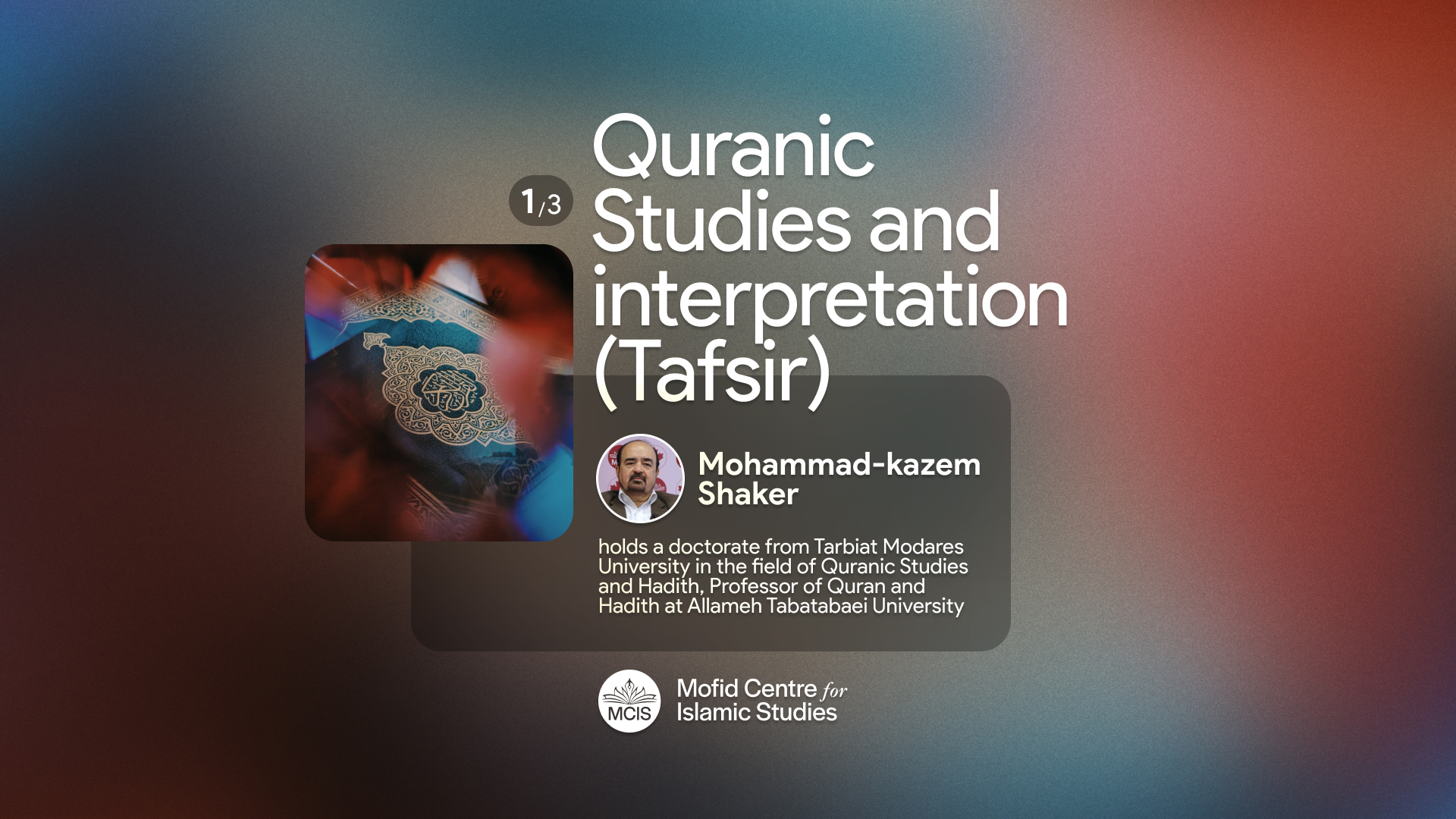
At the beginning of this session a definition for the term “Quranic studies” was presented; it was said that any knowledge whose subject is the Quran, or related to the Quran, is a part of the “Quranic studies”. There was also some discussion on the history of the Quran and Quranic studies. The focus of the second half of this session was “Tafsir”: the different types of Tafsir and their categorization, Tafsir paradigms, Tafsir methods, the different Tafsir approaches and tendencies, and the different expressive styles used for Tafsir. Furthermore, various questions from participants regarding Quranic studies and Tafsir were answered during the talk as well as at the end.